The Ultimate Course Bundle · Autistic-led · Instant access

Re-Storying Autism: a framework for Autistic people, carers and supporting practitioners

Moving from fixing towards understanding. For Autistic people, for families and carers, and for the educators, therapists and practitioners who support them.

Re-Storying Autism is a step-by-step online course created by Autistic co-authors, parents and educators Helen Edgar and David Gray-Hammond. It follows the course book, Re-Storying Autism: A Framework For Autistic People, Carers and Supporting Practitioners, and offers a gentler story than the deficit-based one many people are handed after diagnosis: an Autistic-led framework you can bring into everyday life, the classroom or your practice, at your own pace. It covers sensory needs, meltdowns and overload, burnout, trauma, identity, play and community.

  • Short, bite-size lessons: most take 1 to 3 minutes to read
  • Videos you can pause and come back to whenever you like
  • Course book and Companion Workbook PDFs included free
  • Track your progress

The Ultimate Course Bundle

The full video course, the Course Book and Companion Workbook, plus Helen Edgar’s Neuro-Affirming Glossary e-book and 222-card deck.

£49.99£99.99

Launch price · £49.99 when you join our mailing list, otherwise £99.99

Or £19.99 a month (minimum 6 months). Instant access, no deadlines.

Just the course? £39.99 when you join our mailing list (otherwise £79.99), or £12.99 a month. See all prices.

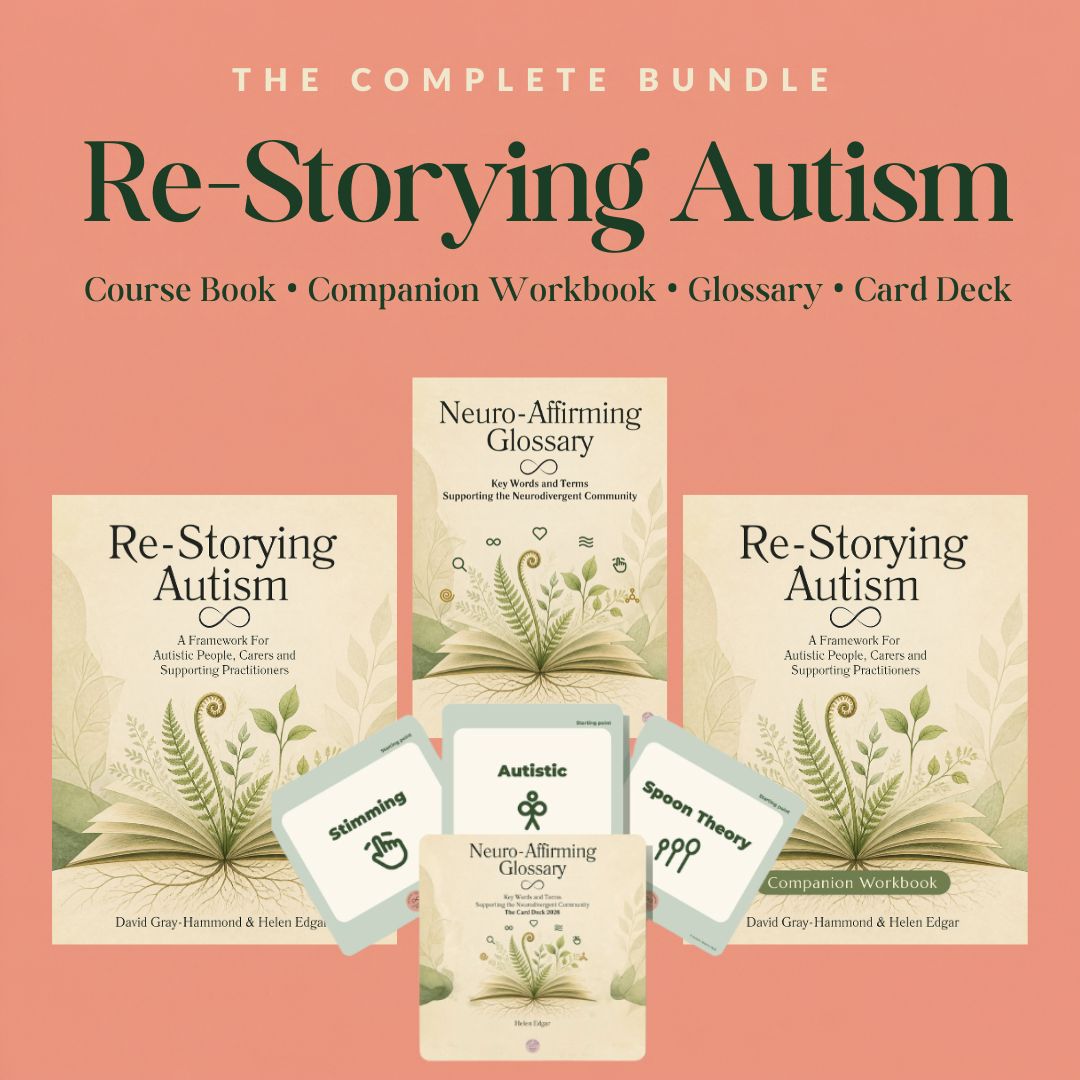
The Ultimate Course Bundle: the Re-Storying Autism Course Book and Companion Workbook, with the Neuro-Affirming Glossary e-book and its Card Deck (Stimming, Autistic and Spoon Theory cards) on a pink background.
Does this sound familiar?

Perhaps you’ve read the leaflets, and something still doesn’t fit.

Most autism advice is written about Autistic people, not by them. Much of it is rooted in behaviourist ideas: managing behaviour, pushing for “independence”, correcting what looks like a problem. Many families tell us this leaves everyone more exhausted, disconnected and worried. You are not alone in noticing this.

Maybe you are a parent noticing your child arrives home from school with nothing left. A carer who senses that the usual strategies are making things worse. Or an Autistic adult, newly identified, wondering why nobody explained any of this years ago.

People come to this course asking:

  • Why does my child fall apart at home after holding it together all day?
  • Is it a meltdown, sensory overload, burnout or something else?
  • How do I support them without pushing them to “mask” and fit in?
  • What language should I use, and what do the labels really mean?
  • Where do I find Autistic voices I can actually trust?
What changes when you re-story autism

From correcting behaviour to building connection

Re-storying is not about positive thinking. It is about gently making sense of how a nervous system learned to survive, how environments shape distress, and how we can build conditions where Autistic people live with dignity, agency and wellbeing.

1

Understand before responding

See attention, communication and sensory experience from the inside, so “difficult” behaviour starts to make sense.

2

Respond to distress with safety

Recognise overload, burnout and trauma early, and know what actually helps instead of what usually makes it worse.

3

Support identity, not compliance

Use language and approaches that protect self-trust, wellbeing and belonging for the long term.

4

Learn from Autistic community

Draw on the collective wisdom of Autistic people, and connect your family to it.

“When we change the story, we change what becomes possible.”Helen Edgar and David Gray-Hammond, Re-Storying Autism
What you will learn

7 modules in short, bite-size chunks: follow them in order or wander

Each module combines video teaching with the matching chapter of the course book, broken into short lessons that most people read in 1 to 3 minutes. Pause a video and come back to it whenever you like: it picks up where you stopped.

Understanding Autistic Experience

Begin with a shift in worldview: how monotropism, the double empathy problem, the ever-changing Autistic self, lilipadding and Autistic culture explain what is often mistaken for difficulty. Drawing on monotropism (Murray et al., 2005) and the double empathy problem (Milton, 2012).

  • See Autistic attention, communication and identity from the inside
  • Replace "how do we change them?" with "how do they experience the world?"
  • Understand why many "problems" are really mismatches between people and environments

Identity, Language and Disability Models

Explore identity-first language, neurodivergence as a socio-political identity, why functioning labels harm, and how the social model and neuronormativity shape everyday life.

  • Choose language that respects Autistic identity
  • Question functioning labels and diagnosis as gatekeepers
  • Understand low-demand approaches and why belonging comes before behaviour

Sensory and Emotional Landscapes

Meet the eight-sense world, including interoception and alexithymia, and learn why overload, stimming, co-regulation and safe retreat are regulation, not misbehaviour.

  • Recognise the eight senses and how each can show up differently
  • Read sensory overload as a nervous-system signal, not defiance
  • Build a home and daily life that honours sensory needs

Autistic Play and Ways of Learning

Discover why Autistic play looks different, why repetition is meaningful, and how interest-led, low-pressure learning supports flow, connection and emotional safety.

  • Value Autistic play, repetition and interests
  • Take the co-regulating adult role with confidence
  • Redefine what success looks like

Burnout, Overload and Connection

Understand Autistic burnout (Raymaker et al., 2020) as an ecosystemic crisis of connection: how it shows up, how it differs from tiredness, how AuDHD changes it, and how reconnection heals.

  • Notice the early signs of burnout, including atypical presentations
  • Understand the three forms of loss
  • Support recovery through reconnection, not pressure

Trauma, Safety and the Emotional Environment

See how cumulative sensory, relational and systemic trauma shapes the nervous system, and how boundaries, predictability and a trauma-informed emotional environment rebuild safety.

  • Understand trauma as an ecosystemic experience
  • See boundaries as protective, not punitive
  • Build safety as the foundation of everything

Learning From Autistic Community

Learn from Autistic culture, collective knowledge and relational ethics, and imagine a future of co-creation, dignity and neurodivergent thriving.

  • Value Autistic community as a living archive of knowledge
  • Learn relational ethics from Autistic spaces
  • Connect families to community, and to a future of belonging
See every lesson in the course
An interactive course, not a stack of videos

Learn step by step and see your progress

  1. Watch or read

    Every lesson has the video and the full course book text. Use either, or both.

  2. Reflect

    Answer the reflective questions right on the lesson page. Your answers and notes save privately, and you can download them any time.

  3. Mark it complete

    Tick off lessons when you’re ready. Pick up exactly where you left off, including inside videos.

  4. Keep and revisit

    Download your reflections, earn a certificate of completion, and return whenever you need.

This course is for you if
  • You are Autistic, diagnosed, self-identified or still wondering
  • You are a parent, carer or family member of an Autistic child, teenager or adult
  • You are a teacher, SENCO, therapist, OT, social prescriber or other practitioner supporting Autistic people
  • You want language for your experience that isn’t medicalised or moralised
  • You are exhausted by pressure to manage, optimise or “fix”
  • You want space to reflect without being corrected

“To re-story autism is to meet a person where they are, not where we expected them to be.”Helen Edgar and David Gray-Hammond, Re-Storying Autism

It is not for
  • Anyone looking to change, cure or normalise an Autistic person
  • Approaches that aim for compliance, including behavioural programmes
  • A quick autism explainer for a one-off session

“Autistic people do not thrive through pressure. They thrive through safety.”Helen Edgar and David Gray-Hammond, Re-Storying Autism

Built on Autistic-led research and lived experience

The Six-Point Framework

The framework understands Autistic wellbeing as emerging when we attend to:

How Autistic experience is understood and framed

The sensory and emotional landscape of the bodymind

Identity, masking, and the cost of survival

Environment, predictability, and relational safety

Power, systems, and institutional harm

Connection, meaning, and Autistic ways of becoming

Rather than isolating “the individual” as the problem, the framework recognises that distress emerges between people, environments and systems.

Praise for Re-Storying Autism

What leading voices are saying

The first edition was a #1 Amazon bestseller, rated 4.7 out of 5

“Re-Storying Autism offers a rare blend of Autistic-led theory, science, lived experience, and practical application that reshapes how families understand support. I especially appreciate how it centers sensory experience, interoception, burnout, identity, and belonging as foundational, not secondary. The reflection questions woven throughout consistently guide curiosity and thoughtful growth. This is the kind of resource that helps people build environments where Autistic people can live with more felt safety, dignity, and self-trust. Highly recommend.”
KM
Kelly Mahler, OTD
Author of The Interoception Curriculum
“Re-framing is the first step toward a new paradigm. ‘Re-Storying Autism’ invites us to move beyond deficit-based narratives and into the neurodiversity paradigm, where Autistic ways of being are understood as valid, meaningful, and human. When we re-story, we shift from fixing people to questioning systems, and from performance to authenticity. At Stimpunks, we see authenticity as our purest freedom: something to be respected, protected, and made possible through environments that allow people to be fully themselves. ‘Re-Storying Autism’ respects, protects, and makes possible our freedom to be authentically ourselves. Highly recommended.”
RB
Ryan Boren
Stimpunks
Created by Autistic people

Meet your teachers

Helen and David are Autistic, ADHD and multiply neurodivergent adults, and also parents, carers and professionals. Helen is a late-identified Autistic and ADHD parent and a former SEND Early Years and Primary teacher of over 20 years. David is an award-winning neurodiversity professional, named on the Diversity Power List for 2025/26. They created the framework from years of community work, consultancy, research and lived experience, because Autistic people were never failing for lack of skills. The stories about them erased context, power and humanity.

Read more about Helen and David
Helen Edgar smiling in a cream fleece, with long red hair and glasses, in a sunlit forest with mossy ground

Helen Edgar

Founder, Autistic Realms
David Gray-Hammond, wearing dark-rimmed glasses and a beard, in front of a rainbow smoke background

David Gray-Hammond

Founder, NeuroHub Connect
Join us

Begin whenever feels right for you.

Launch price

Launch price

Pay once

£39.99£79.99

£39.99 if you join our mailing list (for our first 25 customers), otherwise £79.99.

  • Instant, lifetime access
  • 7 modules plus welcome video
  • Bite-size lessons with the full course book text
  • Free course book and Companion Workbook PDFs
  • Progress tracking and certificate
Buy now

Pay monthly

£12.99a month, minimum 6 months

£77.94 over the minimum term, then cancel any time. Access lasts while you subscribe.

  • Everything in the course
  • Instant access from the first payment
  • No deadlines, no pressure
Pay monthly
The Ultimate Course Bundle: the Re-Storying Autism Course Book and Companion Workbook, with the Neuro-Affirming Glossary e-book and its Card Deck (Stimming, Autistic and Spoon Theory cards) on a pink background.
Launch offer
Everything in one place

The Ultimate Course Bundle

The course and both books, plus Helen Edgar’s Neuro-Affirming Glossary e-book and card deck.

£49.99£99.99

Instant-access digital product: by buying you agree access starts immediately and you lose your 14-day right to cancel. Details

Questions

Frequently asked questions

Who is the Re-Storying Autism course for?

It is for Autistic people (including late-identified and self-identified adults) who want language and understanding for their own experience; for parents, carers and family members who want to support an Autistic loved one in a way that works with them; and for practitioners, such as teachers, SENCOs, therapists, OTs and social prescribers, who support Autistic people in their work. It follows our course book, Re-Storying Autism: A Framework For Autistic People, Carers and Supporting Practitioners. It is not for anyone looking to change, cure or normalise an Autistic person.

What will I get when I join?

Instant access to 7 modules and a welcome video, broken into short, bite-size lessons (most take 1 to 3 minutes to read), about 4½ hours of video you can pause and come back to, the full workbook text for every lesson, interactive reflection prompts, progress tracking, and the 2027 course book and Companion Workbook as free PDF downloads.

How much does the course cost?

The course is £79.99. For our first 25 customers it is £39.99 if you choose to hear from us by email about similar courses and resources (optional: a box you can choose to tick at checkout). You can also pay £12.99 a month, with a minimum of 6 months (£77.94); after that you can cancel any time. The Ultimate Course Bundle adds Helen Edgar’s Neuro-Affirming Glossary e-book and card deck: £99.99 (£49.99 for the remaining launch places, with the mailing-list box), or £19.99 a month for at least 6 months.

Can I get a refund?

Because the course is an instant-access digital product, you are asked at checkout to agree that access starts straight away and that you lose your usual 14-day right to cancel once it does. If the course is faulty or not as described, your statutory rights are not affected, so please contact us. Read the full details on our refunds and cancellation page.

How does paying monthly work?

You pay £12.99 a month and get access straight away. It is a subscription with a minimum term of 6 months (£77.94). After the minimum term you can cancel any time, and your access ends when the period you have paid for ends. If you would rather own the course for life, pay once instead.

How does progress tracking work?

Mark lessons complete as you go and the course shows your progress for each module and overall, remembers the last lesson you opened, and resumes videos where you stopped. There are no deadlines, streaks or scores. Your progress, reflections and notes are saved privately to your account, so they follow you across your phone, tablet and computer, and you can save and download all your notes and reflection answers from the Reflections page whenever you like. Only you can read your reflections.

Do I need an account?

Yes. When you buy, we email you a link to choose a password, and you log in with your email and password. If you forget it, use “Forgotten your password?” on the login page.

Do I have to watch the modules in order?

No. Start wherever feels most useful. The course is designed so that you can follow it step by step from the beginning, or dip into the lessons that matter most right now, and come back to the others when you are ready.
See all questions

Join us in reshaping the narrative

Autistic people flourish when there is safety, agency, sensory consideration and belonging. You’re warmly invited to join us.

£39.99 Re-Storying Autism
Explore the course

Words to know

From the Neuro-Affirming Glossary of Key Words and Terms (2026 Edition) by Helen Edgar, Autistic Realms.

Belonging Starting point
Feeling understood, accepted and valued as you are, without having to perform or explain yourself. Belonging is not the same as being included on condition that you fit in.
Trauma Starting point
The lasting imprint of experiences that overwhelmed a person’s ability to cope. For many Autistic people, trauma comes from everyday life: sensory overload, masking, bullying and being misunderstood.
Burnout Starting point
A long period of deep exhaustion, loss of skills and lower tolerance of sensory input, from years of unmet needs, masking and demands that do not fit. It can affect executive functioning, memory and attention, and lead to withdrawal from everyday life. It is different from depression, though both can co-occur (Raymaker et al., 2020).
Neurodivergent / Neurodivergence Starting point
An individual is ‘neurodivergent’ if they diverge from the dominant societal standards of ‘normal’; neurodivergence is the state of diverging in this way (Asasumasu, 2000, as cited in N. Walker, 2021). Some people may describe themselves as multiply neurodivergent, for example Autistic, ADHD and OCD. The term ‘neurodivergent’ was coined to include people, not to exclude them, and it is not a synonym for Autistic or ADHD.

Read all 222 words free on Helen’s glossary page at autisticrealms.com. Thank you to Helen for writing them.

Subscribe to The Wider Existence, our free newsletter