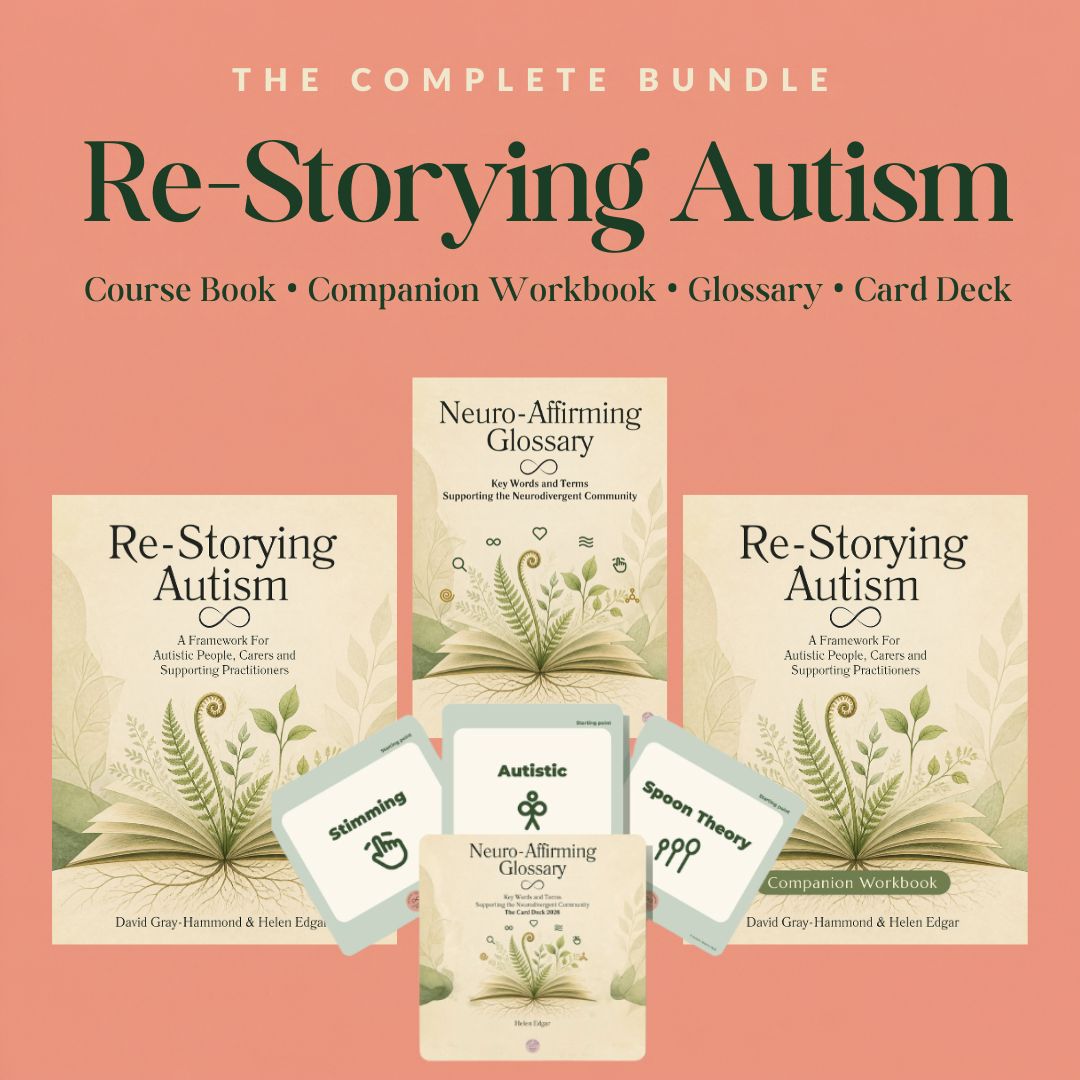
Re-Storying Autism: A Framework For Autistic People, Carers and Supporting Practitioners
The on-demand video course, with instant access and the course book and Companion Workbook PDFs free. £79.99, or £39.99 for our first 25 customers when you join our mailing list. Prefer to spread the cost? £12.99 a month. Or get the Ultimate Course Bundle, with Helen Edgar’s Neuro-Affirming Glossary e-book and card deck, for £99.99 (£49.99 at launch).
The course and both books, plus Helen Edgar’s Neuro-Affirming Glossary e-book and card deck.
£49.99£99.99£99.99
£49.99 if you join our mailing list, for the remaining launch places only, otherwise £99.99. One payment, lifetime access. Or £19.99 a month, minimum 6 months (£119.94).
The full Re-Storying Autism video course: 7 modules plus a welcome video
One course book and one Companion Workbook (PDFs)
Helen Edgar’s Neuro-Affirming Glossary e-book: 222 words and terms, each with its own symbol
The glossary card deck: 222 cards, print-at-home and training versions
A4 glossary posters, the Word definitions file and the “How to use” activity guide
About the mailing list: the lower price is for people who choose to hear from us. If you tick the box at checkout we’ll email you about similar courses and resources from Autistic Realms and NeuroHub Connect. Every email has an unsubscribe link, and you can still keep your course if you unsubscribe later.
Please note: this is an instant-access digital product. Because you can open everything straight away, at checkout we’ll ask you to agree that access begins immediately. This means the usual 14-day right to cancel no longer applies once it does, and there is no refund if you change your mind. Your statutory rights are not affected. Your course starts and ends with a short, optional anonymous survey. It helps us understand what’s changing, there are no right answers, and you can skip it. Read our Terms of Sale and refunds and cancellation policy.
Not sure yet?
Try the free preview lesson, which includes the welcome video, or join the free community webinar.
For practitioners who want to use the course with their clients. Give as many clients as you work with their own access to everything in the Ultimate Course Bundle, for as long as your licence is active.
The course is £79.99. For our first 25 customers it is £39.99 if you choose to hear from us by email about similar courses and resources (optional: a box you can choose to tick at checkout). The £39.99 launch offer for our first 25 customers has sold out. You can also pay £12.99 a month, with a minimum of 6 months (£77.94); after that you can cancel any time. The Ultimate Course Bundle adds Helen Edgar’s Neuro-Affirming Glossary e-book and card deck: £99.99 (£49.99 for the remaining launch places, with the mailing-list box), or £19.99 a month for at least 6 months.
Can I get a refund?
Because the course is an instant-access digital product, you are asked at checkout to agree that access starts straight away and that you lose your usual 14-day right to cancel once it does. If the course is faulty or not as described, your statutory rights are not affected, so please contact us. Read the full details on our refunds and cancellation page.
Is there a certificate?
Yes. When you have marked every lesson complete (and filled in or skipped the short, optional closing survey), you can create a personal certificate of completion with your name and print it or save it as a PDF.
Will you email me marketing?
Only if you ask us to. At checkout there is an optional, unticked box: tick it and we will email you about similar courses and resources from Helen and David at Autistic Realms and NeuroHub Connect (and, for our first 25 customers, the pay-once price is lower). Every email has an unsubscribe link, and you can switch this on or off in your account at any time without losing your course. Emails you need, such as your receipt and password resets, are always sent.
Putting the neurodiversity paradigm into practice by starting from needs rather than behaviour, respecting identity, language and autonomy, and never trying to make someone look more typical.
This means putting a person’s identity first. For example, using identity first language, you would use the term ‘Autistic person’ (not ‘person with autism’, which is person first language). Identity first language is often considered preferable in the Autistic community (Kenny et al., 2016; Keating et al., 2023), but it is always good to ask someone how they prefer to identify and respect their choice.
A feeling of intense happiness experienced by Autistic people often linked to their passions or sensory experiences and connecting with others who they relate to.